I’m
a fan of superhero comics, so, although we spend most of our time
talking about strength of character, I have a special place in my heart
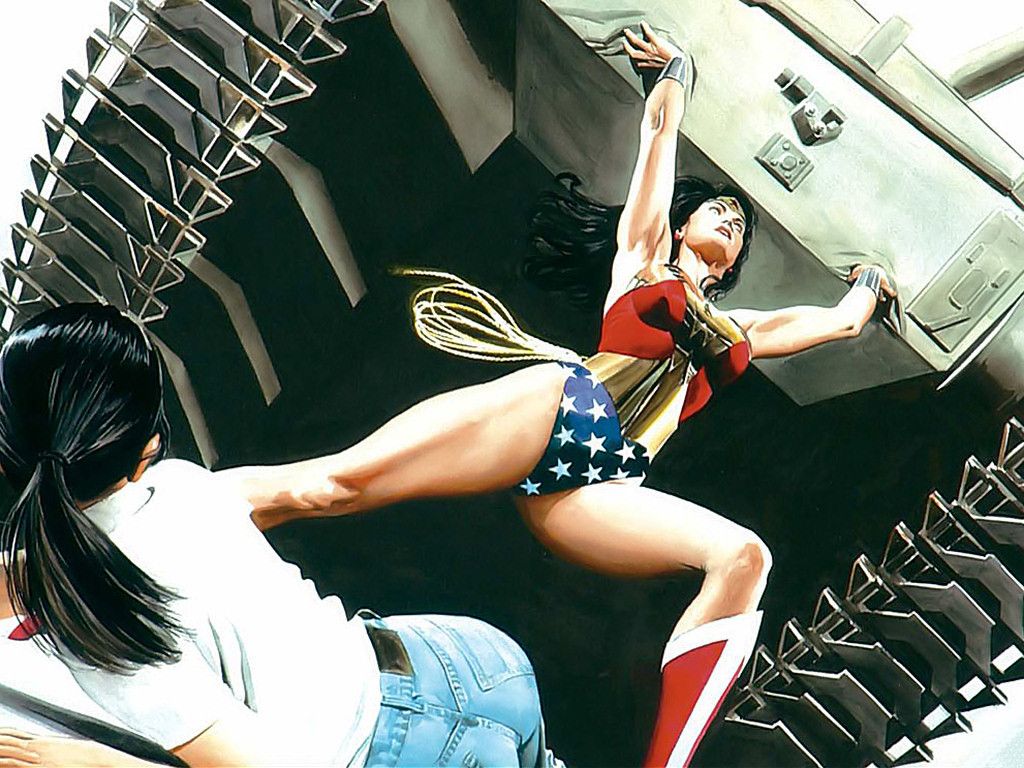
for women who display great physical strength. That’s one of the reasons
why my collectible Wonder Woman figurine shares a shelf with my
Virginia Woolf plushie.
It’s
also the reason for the focus of this post. Superhero comics are
well-known for their portrayal of impossible women’s bodies. These women
often have the kind of statuesque physiques that could only exist on an
actual statue, with torsos so narrow it seems as if they’ve had some
vital organs removed. As if these women weren’t already in danger of
snapping at the waist, they all seem to possess the most common superpower. Perhaps the (usually male) artists are operating under the
assumption that women can relocate their internal organs to protrude
from their chests.
The
most obvious example of this phenomenon is Power Girl, a superhero so
well-endowed that her insignia is a boob window. There is a story,
circulated through the comics-reading community and addressed by blogger
Ragnell, that the character’s impressive cup size is the fault of Wally
Wood, the artist who drew the character when she was first created.
Wood supposedly decided to see if the editors were paying attention to
his work by increasing Power Girl’s bust size every issue. Unfortunately, it
took several issues for anyone to notice, so she’s been stuck with
gravity-defying, back-breaking breasts ever since.
While
the unrealistic breast size of these characters is certainly indicative
of their over-sexualization, I would argue that there’s another aspect
to this decision. In order to perform acts of tremendous
physical strength, female superheroes need to have a well-defined
musculature. However, because physical strength is so thoroughly
associated with masculinity, the artists feel that they need to
over-enhance the character’s feminine appearance. What’s the best way to
do this? Long, flowing, easily-pulled-in-hand-to-hand-combat hair and
fabric-straining breasts.
So it was with delight that I found this review of Venus with Biceps: A Pictorial History of Muscular Women
by David L. Chapman and Patricia Vertinsky. Although I haven’t yet
purchased a copy for myself, I’m more than willing to get the word out
about what looks to be a very interesting work, that not only discusses
issues of gender identity, but also collects a number of images of
unrepentantly strong women.
Perhaps
even better than knowing that this book exists, however, is seeing
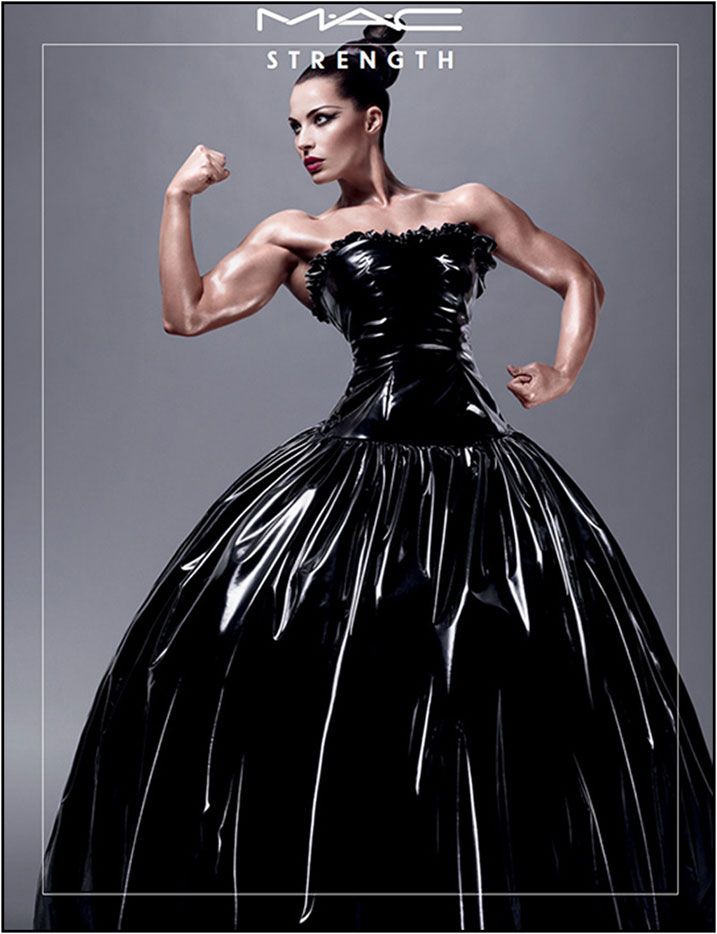
similar images make their way back into popular culture. MAC has
recently launched a new cosmetics line called “Strength,” and its
advertising is a thing of beauty. Not only is the face of the line a
bodybuilder, Jelena Abbou, but the tagline of the campaign is the
greatest I’ve read outside of that amazing 1980s Lego ad: “Flex your
femininity with a colour collection that’s fearless, elegant and strong.
Strike a powerful pose, stand out, redefine the notion of beauty -- and
do it with strength too irresistible to ignore.” That’s advertising
even Wonder Woman would love.
Canada
is known for many things: breathtaking natural beauty, an over-dependence on maple syrup, and a population whose famous humility
makes way for brief bouts of patriotism only once every four years, when
we cheer for the gifted athletes we usually ignore and the professional
hockey players we watch almost constantly. We are not, as a rule,
celebrated as the home of fantastic feminist television shows.
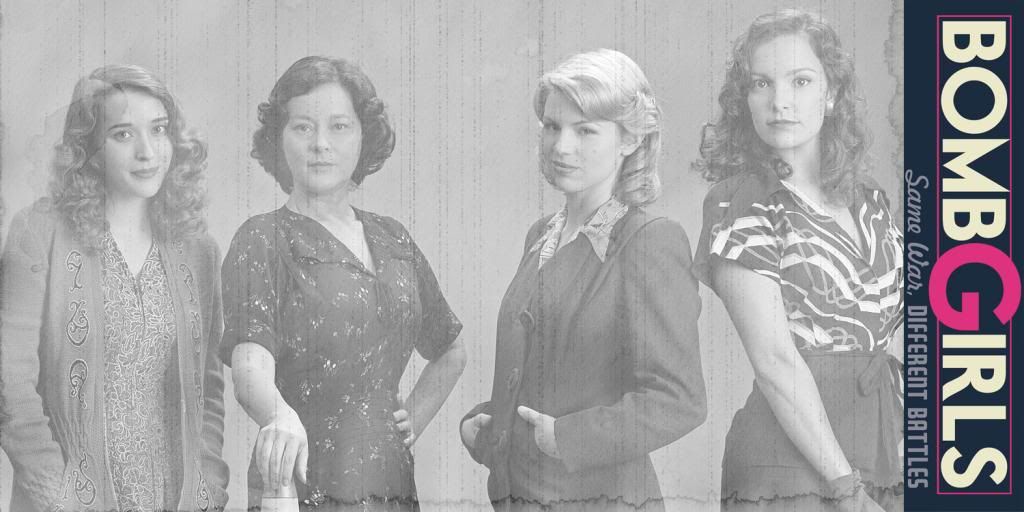
However, with the international success of the homegrown drama Bomb Girls, that’s beginning to change. Set during the Second World War, Bomb Girls
chronicles the trials and tribulations of life on the home front for the
women of Victory Munitions, a bomb factory in Toronto. At work, at
home, and at play, these women simultaneously struggle with the sexist
standards of their time and bask in the new freedom allowed them while
the men fight overseas.
I
mentioned in Monday’s post that this show passes the Bechdel test twice
in the first three minutes of the first episode, but what is even more
notable is that it holds to this pattern for the remainder of the first
season. Bomb Girls
is precisely the kind of show that would exist in a post-Bechdel test
cultural climate, in which women in the media are shown to be thinking,
feeling people with important relationships with other women, all of
whom have full lives that don’t revolve around men.
(Note:
We will only be covering the first season in our analysis. We have,
however, timed these posts to coincide with the release of Season Two in
Canada, so once you’ve bought and marathoned the first season on DVD,
there will be bright, shiny, new episodes waiting for you.)
Lorna Corbett
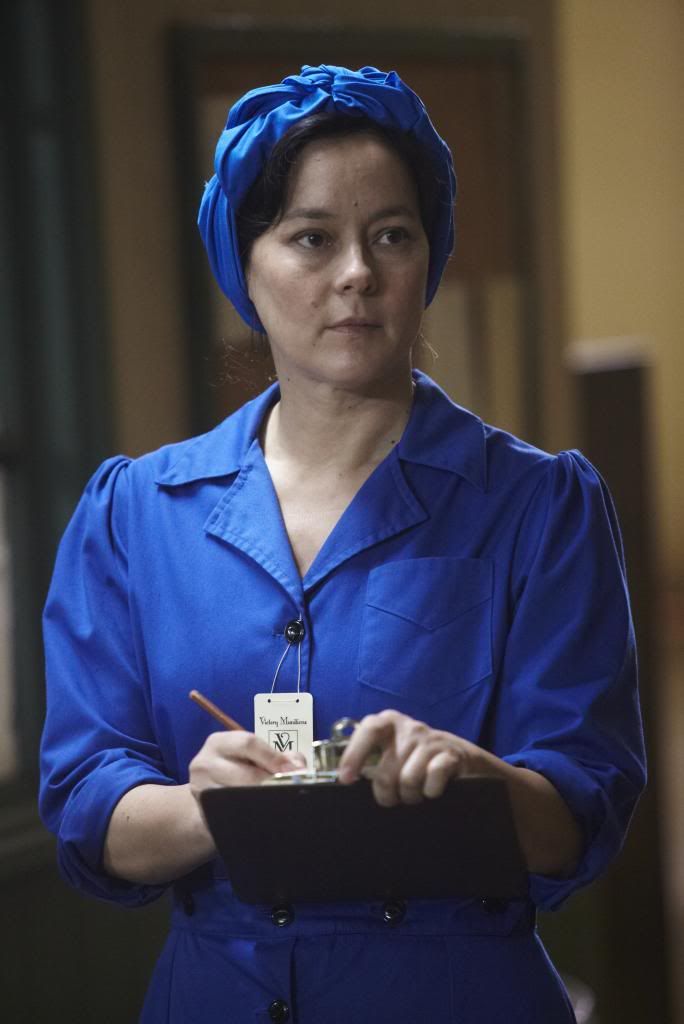
We
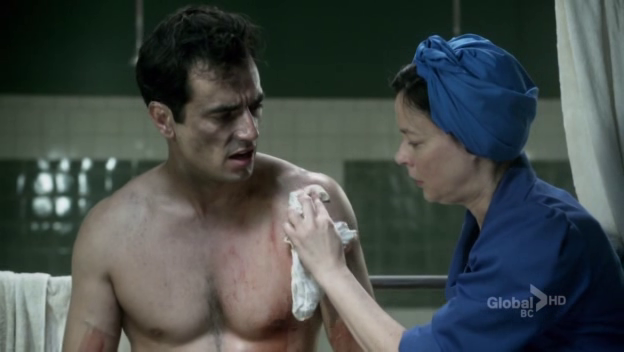
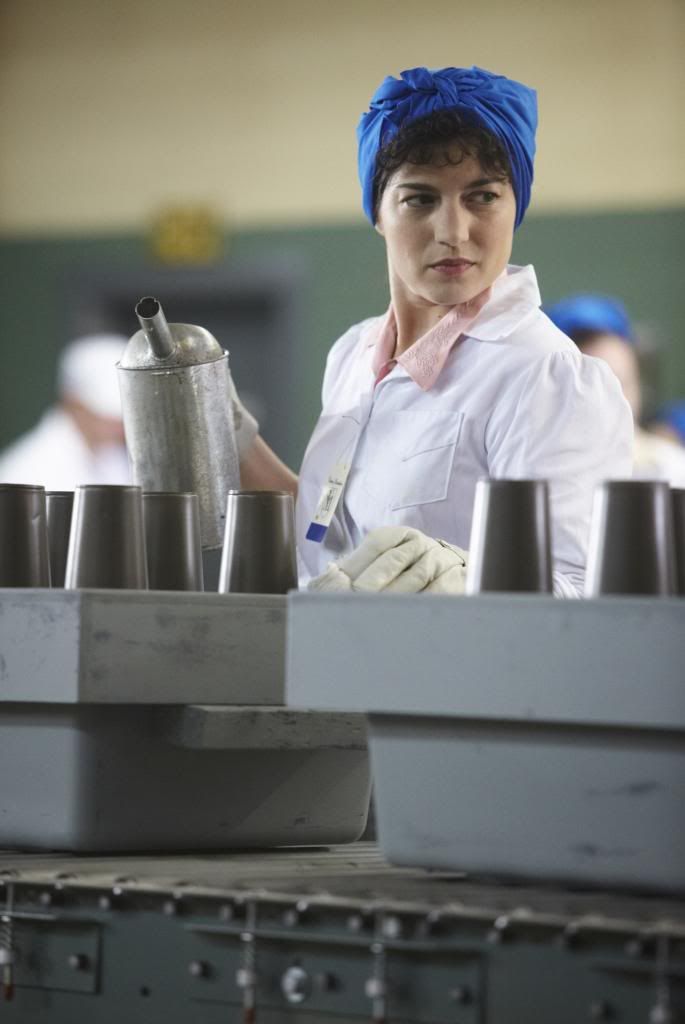
begin with Lorna Corbett, the blue shift matron at Vic Mu, who is just
about the only person in management who seems to understand how to run
the place. It is her job to ensure order in her shift and to inspect her
workers for materials that may spark in the very literal powder keg in
which they work. Her boss, Harold Akins, reduces her job to a simple
task, exclaiming, “For God’s sakes, all you have to worry about is
dressing the girls for their shifts.” But Lorna actually does much more.
She asks that the factory implement a comprehensive sexual harassment
policy and goes on to write it herself. When a bad bomb injures three
male workers during testing, she takes the women’s suggestions for
improvement to Akins. She tells him to publish them in a report and take
the credit for increasing safety and productivity; in exchange, she
asks only that her scapegoated worker be rehired.
In
these two instances, and in many others, she demonstrates that she is
committed to protecting her girls. The best example occurs near the end
of the first episode, when Lorna appeals to a doctor to give a
grievously injured woman worker the same treatment that he would give
the higher priority soldiers. She gives an impassioned speech: “You
can’t let her leave here deformed; it will destroy her future. … Vera is
a soldier. Vera risked her life every day to help win this war. Do not
turn your back on her. If you want to see our boys with bullets in their
guns and bombs in their planes, you will show her the same respect. …
Now go in there, and book the operating room, and you do the surgeries,
no matter how expensive or lengthy. You do your best for that girl.”
Lorna refuses to let women’s role in the war be dismissed and their work
devalued; instead, she argues that they are instrumental in the men’s
success and should therefore be treated with equal care.
Lorna
knows very well what it means to contribute to the war effort. She is
the mother of three grown children, two of whom are fighting across the
pond while she and her daughter do their part at home. She is also the
wife of a World War I veteran, whose experiences during the Great War
left him crippled, both physically and emotionally. The show takes this
opportunity not only to flesh out the well-worn character of the
dissatisfied middle-aged woman, but to explore the effects of PTSD on
the affected person’s family.
As
her husband’s character becomes increasingly complex, we discover what
Lorna has had to live with for twenty-five years. Bob has a drinking
problem and a tendency to be brutally honest in a way that comes across
as callous. He refuses to have sex with her and chooses to complain
about the extravagance of buying a whole pot roast rather than praise
Lorna for making it. He’s not all bad, however. His observations,
cynical as they may be, are often correct, and his decision to revisit
the trauma of his wartime experience in order to write convincing
letters for Edith’s children is admirable. When it comes to their
marriage, however, things have gotten so bad that Lorna becomes
suspicious when he displays any positive emotion.
From
Lorna’s perspective, the problem is that Bob has never made any effort
to move on from his traumatic experience, choosing instead to view the
world “through the lens of a few terrible months [he] had twenty-five
years ago.” He seems to prefer to wallow in his pain rather than
acknowledge the things they have accomplished since the war. While he
remained isolated in his pain, she tried to convince him to let her in,
explaining that “[she] asked, [she] hinted, [she] tried, and then
finally, [she] gave up.” She has been trying to re-forge a connection
for decades, and it’s understandable that she would resent him when he
finally makes an attempt to do the same.
Her
relationship with Bob also explains why she is so determined to help
Vera. Faced with the prospect of seeing another person in her life lose
themselves to depression, she fights back. She has to make Vera what Bob
never allowed himself to become: a person who lives after not dying.
Unfortunately,
most of Lorna’s good advice is reserved for other people. Just as she
makes it her job to protect her girls, she also considers it her duty to
protect her country. In the first episode, she begins a campaign to get
a materials controller, Marco Moretti, ousted from Vic Mu based solely
on his Italian heritage and Italy’s connections to Hitler. She accuses
him of being an enemy spy and then spends most of the first three
episodes trying to prove her suspicions. She believes that people who
have done nothing wrong have nothing to hide, and any investigation will
necessarily find them innocent. Implicit in this notion is the idea
that if you are found guilty of something, you must have done it.
Eventually, she reports him to higher military authorities, which leads
to rumours of his being taken to an internment camp. It is only when
she shares an awkward family dinner with Marco and his mother that she
begins to relinquish her fear and comes to appreciate their cultural
differences, as well as the flaws in her worldview.
While
Lorna claims that her actions are driven by the circumstances of global
conflict, she proves that, in this case, the political is personal.
Smoking out an enemy spy allows her to feel like she’s helping to
protect her sons; the same rationale motivates her to make the bombs
that will kill other mothers’ sons. When she sees Marco with his mother
in his home, she can no longer pretend not to see him as a person.
Unfortunately, this realization coincides with the discovery of their
mutual attraction. It seems that Lorna’s misuse of her power as a native
Canadian to banish an Italian threat was also an attempt to banish the
temptation that threatens her family and marriage; she had to neutralize
what she viewed as a threat to both her home country and her home. This
is further complicated by the fact that Lorna ends up having sex with
Marco and becoming pregnant with his child, willingly letting him into
her life.
This
all brings us to the issue of sacrifice. When asked to deliver a speech
on Armistice Day, Lorna chooses as her focus the topic of individual
sacrifice on behalf of the greater good. While she explicitly links this
concept to the efforts of soldiers in both wars, she also acknowledges
the sacrifices that she and her fellow workers make to support them.
Implicitly, she also talks about herself. Early in the speech, she
delivers a line that she wrote in an earlier scene; the repetition
suggests that it is intended to draw our focus. As she says, “We are all
asked to make sacrifices, and while not every sacrifice is rewarded, it
is our duty to do so.” It seems as if Lorna is speaking about her
marriage, twenty-five years of living with a distant partner in order to
raise three children, two of whom she has offered to her country. By
the end of the speech, however, she seems to be looking to the future:
“Sometimes, you know when a thing is right. What’s a few small
sacrifices on our part when we stand to win back the happiness and
freedom we deserve?” She sees herself as deserving of love and
affection. She sees herself as deserving of a life that takes into
account her needs.
This
all changes when she learns of the pregnancy in the next episode. After
the positive test comes back, she breaks down in front of Marco, saying
that she’s a horrible person who deserves this punishment for all of
the awful things she’s done. She laments, “I thought it was finally my
turn; I’d get my life. And now it’s over.” She has come to the
conclusion that she’s not the hero, doggedly pursuing the enemy; rather,
she is the villain, paying for her crimes.
Verdict: Actual strong female character
Edith McCallum
Edith
is the least developed and, arguably, the weakest character among the
six that we’ll be discussing. At the factory, she is Lorna’s right-hand
woman, the bridge between her and her girls. In the show, she is the
first victim of the war.
Edith
is at work when she learns that her husband’s plane has been shot down,
and her grief is suddenly made very public. While the show makes clear
that the news could have come to anyone, even going so far as to make it
seem as if one of Lorna’s sons had died, it is ultimately Edith who
collapses with grief. The rest of the season chronicles her attempt to
cope with the loss.
Although
she gets less screen time than other characters, Edith’s story is a
fairly compelling one. She continues to work after receiving the news,
taking comfort in her friends and in the activity. Despite the fact that
she barely sleeps, she knows that she must support her family and
diligently does her job until she is the unfortunate victim of
scapegoating after a disastrous testing day. When Lorna tries to justify
her firing by implying that she could have done better on the test,
Edith defends herself: “Aside from not sleeping a wink since my husband
was blown to bits, or worrying how I’m gonna raise two kids, or how I
still can’t tell them Daddy’s never coming home... Aside from all that, I
can’t imagine what took my head out of the game.” In addition to her
grief, she now has to deal with a reputation for incompetence that will
prevent her from finding further employment.
Once
she gets her job back, she still has to deal with the mess that is her
personal life. The rest of her storyline revolves around her refusal to
tell her children that their father is dead. Although both Lorna and Bob
take issue with her decision, Edith is persistent, trying to protect
her children from the kind of pain that she is experiencing. She causes
herself more pain, however, in pretending that everything is fine.
Helping and hindering her in this pursuit is Bob, who pens letters for
the kids in the guise of Edith’s husband before eventually revealing the
truth. In a refreshing change, the show doesn’t actively support Bob’s
decision to end the charade, but instead has him acknowledge that it was
her right to tell them; he apologizes for taking away her agency.
Edith’s
defining moment comes in the second episode. Vera has asked to brush
Edith’s hair, and in a revealing moment, Edith laments, “I guess the war
pretty much kicked the girly girl out of us, didn’t it?” She is not
just talking about coveralls and turbans, but about the reality that she
faces as a single parent, having to become mother and father and
breadwinner.
This
week’s Miscellaneous Mondays post features a talk given by
communications expert Colin Stokes about the profound influence that the filmic hero’s journey exercises on the audience. In this video, he
discusses the limitations inherent in this trope and advocates for a
paradigm shift from a hero’s journey, focused on an individual (usually a
man) who either defeats other people or claims them as prizes, to a
heroes’ journey, focused on a team comprised of people of all genders, whose goal
is to improve themselves and those around them.
Now
for a bit of a teaser. Whether you have been basing your viewing habits
on the Bechdel test for years or had never heard of it before watching
this video, you might be interested to know that the television show
that we’ll be talking about in our next series of posts passes the test
two times in the first three minutes.
In our survey of the subversive qualities of the ladies of Adventure Time,
it’s only right that we end with Princess Bubblegum. For the better
part of three seasons, Princess Bonnibel Bubblegum (hereafter Bubblegum,
Bonnibel, Peebles, or just PB) occupies the role traditionally reserved
for the princess prize, the woman who will be given to the hero as just
deserts for his impressive deeds. Except, of course, that that’s not
even remotely what happens.
Just
as Marceline operates within and against the conception of vampires
derived from literary and folkloric sources, the character of Bonnibel
is informed by a long tradition of fairy tale princesses. Her skin,
hair, and wardrobe are all overwhelmingly pink. She has a tendency to
speak in a formal register, stopping just short of speaking with the
royal “we.” She serves as an almost preternaturally all-knowing guide to
our hero, and it is her job both to send him off on quests and to
ensure that he learns the proper lesson from his adventures. She even
bids him farewell by waving a handkerchief.
The
handkerchief incident is an excellent indicator as to the show’s
approach to Bubblegum’s princess status; when seeing Finn off, she
actually stops herself mid-sentence, says, “Wait a minute,” and produces
the cloth in order to get the look right. If a princess is sending her
hero off, she has to cut a suitably dramatic figure. The same kind of
transparency exists in her speech patterns. While she clearly strives to
stay in royal character, she also regularly slips into informal diction
and slang, mixing declarations that she “will be back on the morrow” (a
phrase which, in context, is itself a play on assumptions about formal
language) with words like “y’all” and “aight.” Even the lessons she
imparts are delivered in unexpected ways. When Finn and Jake disregard
signs telling them not to enter a dungeon -- signs that Bubblegum had
them put up -- she tries to make them see that the lesson was to obey
her orders. The boys offer a different lesson and, when Bubblegum finds
it lacking, Finn amends it: “I learned that you are a very...
intelligent princess?” Her response? “You’re darn right I am.” As if all
this weren’t enough to let us know that we’re dealing with a different
kind of princess, the swan she rides can shoot lasers. Because of the
show’s post-apocalyptic setting, it almost seems as if Bubblegum has
tried to meld her reality with our storytelling tropes, revealing the
performativity of princessery in the process.
Further
hammering this point home are Bonnibel’s other pursuits. She is a
polyglot, speaking German and English as well as understanding Korean.
Like the sugar-based lovechild of Pinkie Pie and Marie Curie, she spends
her time either attending bizarre events (our particular favourite is
the Whistling Choir Death Match Championship) or doing Science (the
capital “S” is always implied). We’re most interested in the latter
interest, because science has typically been considered masculine
territory.
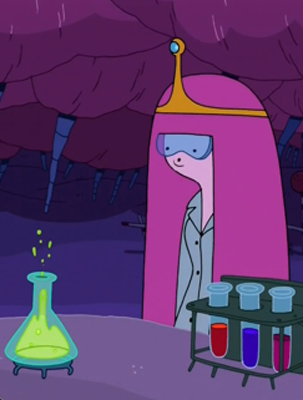
In Adventure Time,
however, the first episode opens with Bubblegum conducting an
essentially impossible scientific experiment while Finn looks on,
fascinated and uncomprehending. It’s a daring move, because the first
time we meet Bubblegum, she messes up. In another show, this might set
the standard for her character: she tries to perform experiments beyond
her ability and Finn saves the day by fighting the monsters that result.
Instead, she has him babysit her subjects while she fixes the situation
herself. In addition, the problem that she’s trying to solve is death
itself, and she triumphs. Accidentally raising a candy-eating zombie
hoard from the dead can be overlooked when it leads to unlocking the
secret of resurrection.
Adventure Time
manages to strike this kind of balance in many aspects of Bubblegum’s
character. She is obsessed with science, once going so far as to use a
wide variety of scientific approaches and equipment to make “the most
perfect sandwich that has ever existed or ever will exist within the
confines of space-time.” In this instance and one other, when she stays
up for eighty-three hours straight in order to make herself an immortal
replacement, the show suggests that this obsession may be unhealthy. At
the same time, however, the vast majority of her experiments and
inventions are helpful, practical, and just downright cool, and the show
actively supports her accomplishments. She also has a tendency to
engage in displays of irrational anger, but these moments are tempered
by the hyper-rationality that dominates the rest of her life.
Although
she often has to be saved, she is clearly able to take care of herself.
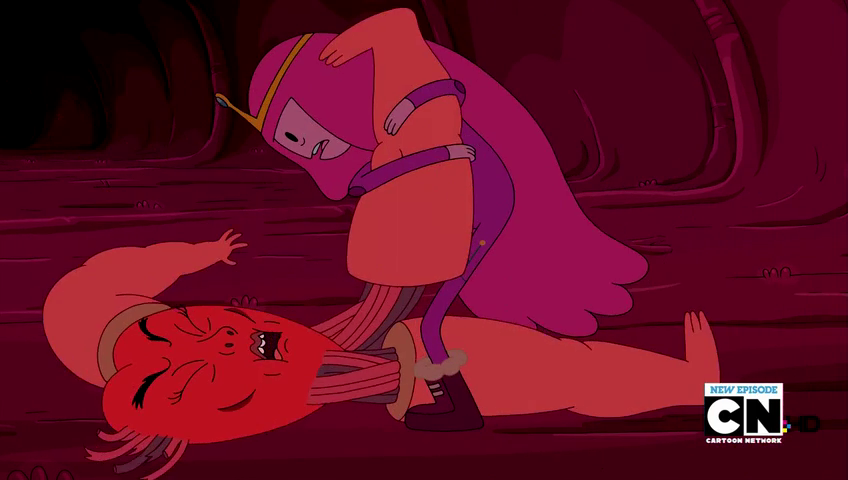
The best example of this occurs in the episode “Lady and Peebles,”
which follows Bubblegum and Lady Rainicorn as they embark on their own
adventure to save Finn and Jake from the nightmarish Ricardio the Heart
Guy. Not only does PB prepare for every eventuality, but when her
equipment is stolen and Lady injured, she nevertheless sets forth to
save her friends, all while carrying the much larger Lady on her
shoulders. When she discovers that Ricardio has made himself a body and
intends to marry her, she agrees, on the condition that he must beat her
in hand-to-hand combat. She exploits his body’s poor design, literally
ripping him limb from limb before delivering this amazing speech: “You
think we’re intellectual equals? It only took me seconds to get you off
your guard! And this ‘body’ you’ve designed is self-congratulatory
garbage! See, I know a thing or two about building a body out of
biomass, and you don’t
leave your heart exposed!” When Ricardio protests that he only wanted
to impress her, she simply replies, “You didn’t.” Finally, because she
hadn’t quite reached a high enough level of BAMFitude, she drags Finn,
Jake, Lady Rainicorn, and the Ice King back to the Candy Kingdom, where
she cures them and builds the Ice King a new heart. Still, while she
combines brains and brawn, she doesn’t quite fit the warrior princess
mold. She doesn’t seem to enjoy fighting, using it not to replace, but
to support her intellectual smackdowns.
In
addition to her duties as princess of the Candy Kingdom, she is queen
of the trolls. Not only does she help Jake with his haunted house trick,
but she uses her knowledge that Finn wants to kiss her to engage in a
little good-natured teasing. She makes a habit of exploiting her
connections to a hero to get him to do menial tasks for her, like
watching her princess plant or putting up signs. The pièce de résistance
is her decision to make Finn and Jake believe that she’ll be
decapitated if they don’t deliver tarts to an official ceremony on time,
purely to ensure that they won’t eat the tarts themselves.
This
attitude toward Finn may explain, at least in part, why they don’t
really work as a romantic pairing. While Finn entertains the idea that
the (probably several times) eighteen-year-old Bonnibel could come to
love his thirteen-year-old self, she seems to understand that they are
at different places in their lives. This is confirmed in “Too Young,”
when the thirteen-year-old Bubblegum displays feelings for Finn that her
older self dismisses as a mere childish whim. He constantly tries to
impress her, but she cannot -- or does not let herself -- see his
actions as legitimate romantic advances. In fact, her willingness to
tease him about wanting to kiss her may stem from her inability to
figure out a way to let him down gently. This is suggested by the events
of “Incendium,” when Finn puts his head in Bubblegum’s lap and she
cannot get away fast enough. Before she goes, she does manage to express
how awkward he has made their friendship: “Finn, no. Come on, Finn,
don’t be weird.” Finally, when Jake suggests that jealousy lies behind
her objection to Finn’s relationship with Flame Princess, she tells him
that it’s not about “some petty love triangle.”
Jake
speaks here as the voice of narrative convention. In other stories, the
girl who’s been resisting the boy’s advances might show interest after
he’s moved on, moving him out of the so-called “Friend Zone” only after
he’s already left. Adventure Time
doesn’t even entertain the idea of friend-zoning, instead replacing it
with an increasingly foreign concept we might call “being friends.” What
makes this particularly impressive is that it shuts down the easy drama
represented by the love triangle in order to show respect to the
characterization of all parties involved. It’s a bold move, and as
people who would prefer not to have to see another lazy love triangle
storyline for about a decade, we appreciate it.
When
she’s trying to explain to Finn why he shouldn’t date Flame Princess,
Bonnibel makes a particularly revealing argument: “Finn, sometimes you
want someone, and you want to kiss them and be with them, but you can’t,
because responsibility demands sacrifice.” Regardless of your shipping
preferences, this says a lot about her approach to life as a princess.
In “Too Young,” she talks about the toll royal responsibility takes,
stating that she would love to remain thirteen in order to enjoy the
freedom of childhood; however, she ultimately decides to age back into
rulership because her people need her, “and that comes first.” She is
motivated primarily by a need to do right by her subjects, keeping them
in ignorance when it will save their lives and planning to torture the
Ice King in order to cure an epidemic. She is a monarch first and a
person second.
The
most interesting treatment of PB’s approach to leadership comes in the
“Goliad” episode. Faced with her own mortality following her near-death
at the hands of the Lich, Bubblegum decides to make a successor who can
live forever. That successor turns out to be Goliad, a rather horrifying
piece of Nightmare Fuel made from Bubblegum’s DNA. Because PB stayed
awake for days making the unholy creature, Finn and Jake take Goliad out
for her first lesson in leadership. Goliad learns the wrong lesson,
claiming that enraged shouting and psychic/telekinetic manipulation are
the best ways to get people to do what she wants. When it comes time for
Bubblegum to correct her creation’s conception of leadership, she tries
to figure it in terms of a symbiotic relationship between ruler and
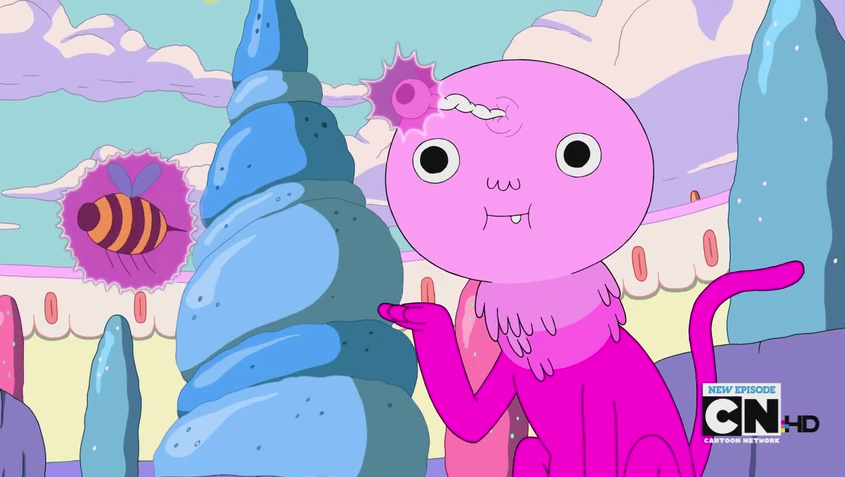
subjects: “Goliad, let me tell you something about leadership. You see
this fat bee? She gets pollen from this flower, but she’s gentle and
makes the flower happy and pollinated. They both get what they need. And
that’s how a leader should be.” Goliad rejects this reality and
substitutes her own.
To
prevent Goliad from indulging her megalomaniacal tendencies, Bubblegum
makes another candy sphinx, this time using Finn’s heroic DNA to make
Stormo, a selfless creature willing to sacrifice himself to save the
kingdom. Here’s where things get interesting, even though that’s
technically where we leave the episode. If we are to infer that Finn’s
heroic DNA made Stormo heroic, we have to wonder what Goliad’s actions
say about Bonnibel herself. Is it her DNA that produces a creature
willing to rule others by force? Or, considering the fact that Goliad
initially sees this forceful behaviour demonstrated by Jake, is this
merely a comment on the malleability of children’s minds and the
necessity of giving them healthy examples to emulate? At the very least,
it shows us that Bubblegum is willing to enter ethically dubious
territory in equipping her ideal ruler with psychic powers.
What we appreciate about Bubblegum is precisely what we enjoy in all of the Adventure Time
characters we discussed: they are successful subversions of familiar
character types that demonstrate what you can create when you expand
these types into nuanced, fully-formed people. The show gives the lie to
the claim that children’s programming is simplistic and
unsophisticated. On the contrary, Adventure Time proves
that a simple concept can give its creators room to create, to expand
upon ideas, situations, and characters that television shows and films
intended for adult audiences leave unexplored. It is a cartoon that
draws its women in fine detail, rendering them human with all the
accompanying strengths and flaws inherent in the term. If enjoying some
legitimately strong female characters means that we also have to adjust
to a world in which the amount of candy matter present in one’s body
determines one’s age and buttermilk is instrumental in summoning demons,
we have to say we’re okay with it.
Verdict: Actual strong female character
Edit: Sometimes
when you have a deadline looming, you publish work that is less than
your best. Luckily, we’re giving ourselves something of an extension to
ensure that Princess Bubblegum gets the treatment she deserves.
We
have had it brought to our attention by Adventuretitan that we missed a
major issue in the “Lady and Peebles” episode. While we focused on
Bubblegum’s ability to defend herself, we neglected to discuss what she
was defending herself from. From the moment that Bubblegum and Lady
Rainicorn enter Ricardio’s lair through a sphincter, the episode is full
of the imagery and symbolism of violated bodies. While flying through a
dark chamber, Lady and Bubblegum are accosted by a multitude of
groping, disembodied hands. After temporarily impairing her sight, the
hands strip Bubblegum of her bag of supplies, leaving her vulnerable.
Once
she and Lady enter the chamber that houses Ricardio, they are
confronted with the body of the Ice King, whose chest bears a gaping
wound. Next, they see the unconscious Finn and Jake, who have been
poisoned by zanoits, which seem to replicate some of the effects of date
rape drugs. Finally, Ricardio reveals the reason for this horrific
display: “I thought I only wanted your heart, but I was wrong. I was
unfair to you. I want the full package.” He has made himself a body, and
the interest he takes in Bubblegum removing some of her clothing
suggests that he is planning to use his new body to violate hers.
In
light of this, Bubblegum’s ability to best Ricardio on a physical level
can be seen not only as a display of badassery, but as an assertion of
bodily autonomy. She annihilates his capacity to enact sexual violence,
not just preventing a sexual assault, but incapacitating a sexual
assailant. Even better is the fact that the narrative upholds her
actions as very much the right thing to do.
Another
important moment we wanted to discuss occurs in a situation where
Bubblegum’s body has actually been compromised. In “Mortal Folly,” Finn
uses the power of love (or liking someone a lot) imbued in the sweater
Bubblegum made him in order to defeat the Lich. However, when he
attempts to use the same sweater -- and, therefore, the same power -- to
restore the possessed Bubblegum’s true self, nothing happens. As Finn
observes, “Liking her didn’t work. She’s unstoppable.” For once, the
power of love isn’t enough to save a woman. We may be jaded as a result
of overexposure to Disney movies, where the healing properties of “true
love’s kiss” are apparently limitless, but the idea that a woman can
have strengths and weaknesses that have nothing to do with romantic
emotion is pretty excellent. It’s sad that we even have to celebrate
such a thing, but we’re willing to give kudos to any show that does it
right when so many do it wrong.